
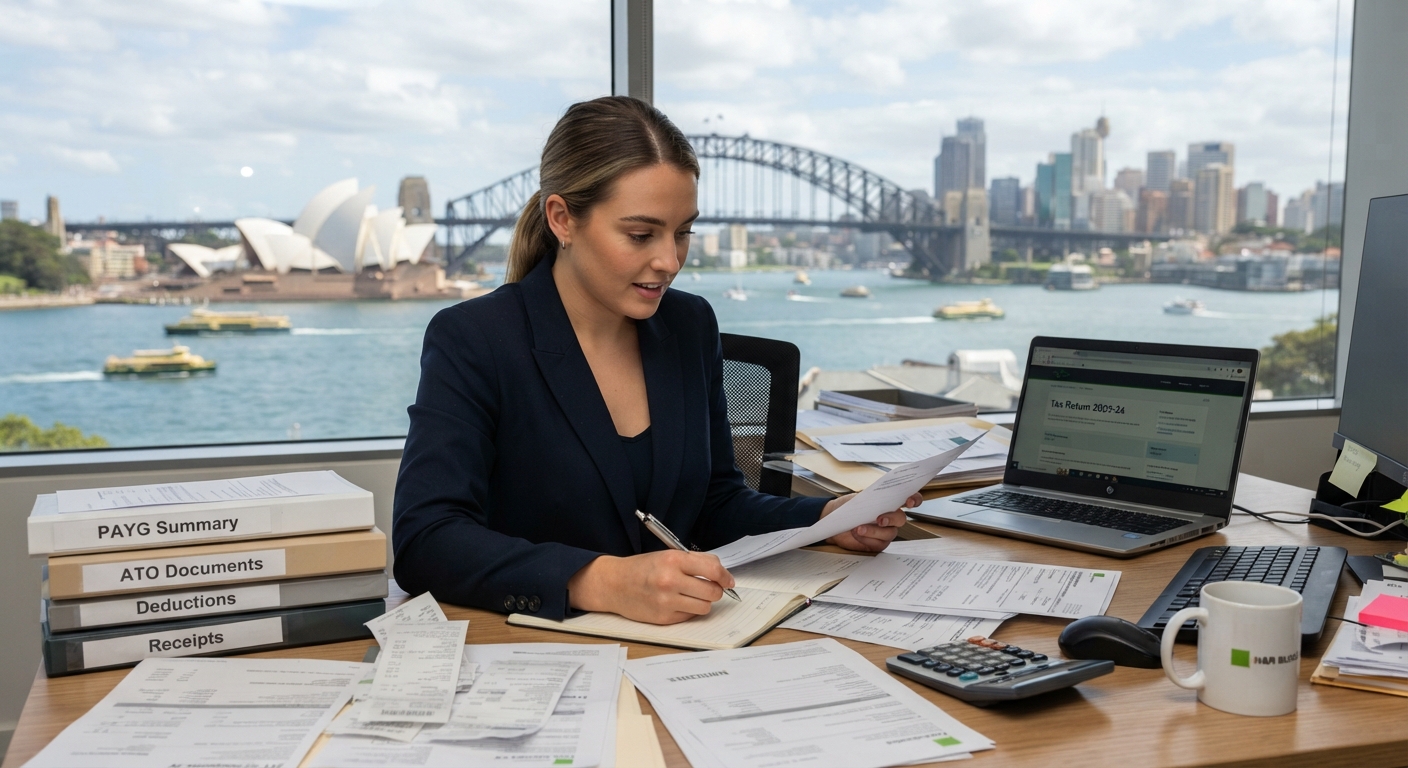
Tax time in Sydney has a familiar rhythm. The financial year ends on 30 June, and by early July, employees start checking their myGov inbox for income statements, property investors dig out rental summaries, and newcomers to Australia wonder which overseas records they need to keep. What separates a smooth lodgement from a stressful one usually comes down to preparation completed before the return is started.
Missing an income statement, forgetting a bank interest record, or mixing personal expenses with work-related claims can delay a refund, trigger ATO scrutiny, or require an amendment later. For anyone lodging a tax return in Sydney, having the right documents organised in advance makes the process faster and far more accurate. This guide explains what to prepare, what the ATO already knows, and where professional advice becomes worthwhile.
Understanding the Australian Tax Return System
Australia’s individual income tax system operates on a financial year running from 1 July to 30 June. When you lodge a tax return, you are telling the Australian Taxation Office (ATO) how much income you received during that period and which deductions you are claiming. The ATO then assesses your taxable income and calculates whether you owe additional tax or are entitled to a refund.
A tax refund arises when the tax withheld from your income during the year exceeds your actual tax liability. A tax bill occurs when too little tax was withheld or when additional income—such as investment earnings or foreign income—pushes your liability higher. Tax offsets work differently from deductions: a deduction reduces your taxable income, while an offset directly reduces the tax payable. Understanding this distinction matters when you review your return.
The ATO administers the system, matches data from employers, banks, health insurers, and government agencies, and issues notices of assessment. Accurate records are not optional—they are the foundation of a compliant return.
Who Needs to Lodge an Australian Tax Return?
Not every Australian needs to lodge a tax return, but many people who assume they do not actually should. You may need to lodge if you were an Australian resident for tax purposes and received taxable income such as salary or wages, Centrelink payments, investment income, or business income. Employees who earned below the tax-free threshold but had tax withheld may also need to lodge to recover that withholding.
Contractors and sole traders generally need to lodge, as do property investors and anyone with foreign income. If you received taxable government payments or had tax withheld from any source, lodging is often necessary. If you are unsure, the ATO provides a “Do I need to lodge” tool. Some individuals who do not need to lodge may still need to submit a non-lodgment advice to confirm their situation.
Complete Australian Tax Return Checklist – Documents You Should Prepare
This is the practical core of tax preparation. Gather these records before you open myTax or meet your accountant.
Personal Identification and Tax Information
Have your Tax File Number (TFN), full legal name, date of birth, current residential address, contact details, and Australian bank account details ready for any refund. If you have lodged before, previous return information helps confirm consistency. Your bank details must be correct—the ATO can hold a refund for up to 90 days if account details are invalid
Employment Income Documents
You need income statements from every employer. The ATO explicitly advises waiting until your employer marks your income statement as “Tax Ready” before lodging . Include bonuses, commissions, allowances, and any employment termination payments. If you worked for multiple employers during the year, every income statement must be accounted for, even if the amount seems small.
Government Payments and Other Income
Taxable government payments, including some Centrelink payments, need to be declared. Payment summaries or income statements from Services Australia should be checked. Not every government payment is taxable, so confirm the status of each payment rather than assuming.
Bank Interest and Investment Income
Bank interest statements, dividend statements, managed fund distribution statements, and trust distributions all form part of your assessable income. Even though the ATO pre-fills much of this data, you must check every entry. Pre-filled information can be incomplete or incorrect, and lodging based solely on pre-fill without verification is a common source of errors.
Rental Property Income and Expenses
Property investors need rental income statements, property management reports, mortgage interest records, council rates, water charges, insurance, repairs and maintenance receipts, strata levies, depreciation schedules, and capital works records. The ATO requires records from before you purchased the property through every year of ownership and for at least five years after sale . Distinguish between repairs (often immediately deductible) and capital improvements (generally depreciated over time). If you co-own the property, income and expenses must be attributed according to legal ownership interests.
https://www.ato.gov.au/api/public/content/6121d64f291b43bba7393d677224c37c?v=0b6a1f49#1#8#1
Business and Sole Trader Income
Sole traders should have sales records, business bank statements, customer invoices, supplier invoices, vehicle expense records, equipment purchase receipts, depreciation schedules, BAS statements, GST records, and ABN information. Keep business and personal transactions separate wherever possible. If you use a vehicle for business, a logbook or odometer records support your claim.
Foreign Income and Overseas Financial Records
If you are an Australian resident for tax purposes, foreign employment income, overseas bank interest, foreign investment income, and foreign rental income are generally assessable. Records should include overseas income statements, foreign tax payment evidence, and currency conversion calculations. However, tax residency is not the same as immigration status. A person may hold a visa but not be an Australian tax resident, or be an Australian tax resident without citizenship. Temporary residents may have different treatment of foreign income. These rules are complex, and general guidance cannot substitute for advice on your specific circumstances.
Private Health Insurance Information
Your private health insurance statement shows the premiums you paid and the rebate you received. This information is relevant to the Medicare levy surcharge. For 2025–26, singles with income above $101,000 and families above $202,000 may face the surcharge unless they hold appropriate private hospital cover. The surcharge is calculated on income for MLS purposes, which differs from taxable income.
Superannuation and Personal Contributions
If you made personal superannuation contributions and intend to claim a deduction, you need a valid notice of intent to claim and acknowledgment from your fund. Employer super contributions are not deductible to you personally—they are already treated concessionally within the fund.
Tax Deductions – What Expenses Should You Keep Records For?
An expense related to work is not automatically deductible. The ATO requires that you spent the money yourself, were not reimbursed, and can substantiate the claim with written evidence. You cannot claim a deduction for expenses you did not incur.
Work-Related Expenses
Common claims include uniforms and protective clothing, tools and equipment, professional memberships, union fees, work-related education, and eligible travel. Each category has specific rules. For example, conventional clothing is generally not deductible even if worn to work, and self-education is only deductible if it relates to your current employment.
Working From Home Expenses
Electricity, internet, phone, and home office expenses may be claimed using a fixed-rate method or actual-cost method, depending on your circumstances and records. The ATO updates these methods periodically, so confirm the current approach before calculating a claim. You cannot claim expenses your employer has reimbursed or that relate to private use.
Vehicle and Travel Expenses
Ordinary commuting between home and work is not deductible. Work-related travel—such as traveling between two workplaces or carrying bulky equipment—may be deductible. A logbook or odometer records support claims under cents-per-kilometre or logbook methods. Parking and tolls may be claimed only where they relate to deductible travel.
Donations and Gifts
Donations of $2 or more to a deductible gift recipient (DGR) are generally deductible. Keep the official receipt. Not every charity has DGR status, so confirm before claiming .https://adfconsumer.gov.au/2026-tax-time/
Other Eligible Deductions
Tax agent fees for preparing your return, income protection insurance premiums (in limited circumstances), and certain other expenses may be deductible. Always check current ATO guidance before claiming.
Tax Information for People Who Have Recently Moved to Australia
New arrivals face a tax system that does not always match their expectations. The most important concept to grasp is tax residency.
What Is Australian Tax Residency?
Tax residency is determined under Australian tax law, not by visa status or citizenship. The primary test is the “resides” test, which considers factors such as physical presence, intention and purpose, family ties, business or employment connections, and social arrangements. If you do not reside in Australia under that test, you may still be a resident under the domicile, 183-day, or Commonwealth superannuation tests . The ATO and the Department of Home Affairs apply different rules—you can be a tax resident without being a citizen or permanent resident.
Do New Australian Residents Need to Declare Overseas Income?
Australian tax residents are generally taxed on worldwide income. However, temporary residents may be exempt from tax on certain foreign income. The rules are nuanced and depend on your residency category. Foreign income must be converted to Australian dollars, and foreign tax offsets may reduce double taxation. Do not assume that all overseas income is automatically taxable, and do not assume it is automatically exempt.
What Documents Should New Residents Prepare?
Keep your date of arrival, visa and immigration records, overseas income statements, foreign bank interest records, foreign investment documents, evidence of foreign tax paid, Australian employment income statements, TFN details, and records showing when your tax residency changed. If you arrived partway through the financial year, the date matters significantly.
What If You Arrived in Australia Partway Through the Financial Year?
Part-year residents receive a part-year tax-free threshold. For 2025–26, this consists of a flat $13,464 plus a pro-rated portion of the remaining $4,736 based on the number of months you were an Australian resident, including the month you arrived . This threshold is lower than the full $18,200, which means you may pay more tax than a full-year resident on the same income.
Important Tax Return Information for International Workers in Sydney
Sydney’s international workforce includes professionals on employer-sponsored visas, working holiday makers, international students who work part-time, and individuals transferred to Australia by overseas companies. Each group may face different tax outcomes. Working holiday makers on 417 or 462 visas are subject to specific tax rates and must complete the relevant question in their return. Temporary visa holders may have different treatment of foreign income. International students who work may need to lodge if they earn above the threshold or have tax withheld.
We regularly assist international workers who are unsure whether their overseas salary, foreign rental income, or home-country investments need to be declared in Australia. The answer depends on your tax residency status, the type of visa you hold, and any applicable temporary resident concessions. We also help clients understand how foreign tax offsets work, how to convert overseas amounts into Australian dollars correctly, and what records to keep if the ATO asks questions later. If your situation involves foreign employment income, multiple jurisdictions, or uncertain residency, professional advice is worth the cost—and getting it before you lodge is far simpler than amending a return afterwards.
What Information Does the ATO Pre-Fill in Your Tax Return?
When you use myTax through myGov, the ATO pre-fills information reported by third parties: employment income from income statements, bank interest, government payments, private health insurance details, and some investment income. Pre-fill is a convenience, not a guarantee. The ATO advises waiting until income statements are marked Tax Ready and checking every pre-filled entry . Pre-filled data may be incomplete, particularly for income from overseas sources, some trusts, or employers who have not finalised their reporting. Lodging before all information is available is one of the most common causes of amendments.
Important Australian Tax Return Dates and Deadlines
If you lodge your own return, the deadline is 31 October each year. If 31 October falls on a weekend, the due date moves to the next business day . If you use a registered tax agent, they generally have access to later lodgement schedules, but you must engage them before 31 October . If you lodge between 1 July and 31 October and receive a tax bill, payment is generally due by 21 November . Missing the deadline does not remove your obligation—lodge as soon as possible if you are overdue, and contact the ATO if you are having difficulty.
Common Mistakes to Avoid When Lodging an Australian Tax Return
- Lodging before all income information is ready. Waiting for income statements to be marked Tax Ready prevents most pre-fill errors.
- Forgetting a second employer. Every income statement must be included, even from short-term or casual work.
- Missing bank interest. Even small amounts are assessable, and the ATO receives this data.
- Claiming expenses without records. Written evidence is required for most claims.
- Claiming personal expenses as work-related. Private expenses are not deductible.
- Forgetting rental property income. All rental income, including short-term rentals and sharing-platform income, must be declared.
- Incorrectly reporting foreign income. Residency status determines treatment, and errors here can be costly.
- Confusing tax residency with immigration status. A visa does not automatically make you a tax resident, and citizenship is not required for tax residency.
- Incorrect bank account details. Invalid details can delay your refund by up to 90 days. Failing to review the return before lodgement. Always check the summary and pre-filled data.
Should You Lodge Your Tax Return Yourself or Hire a Registered Tax Agent?
Self-lodgement through myTax suits many taxpayers with simple employment income, bank interest, and straightforward deductions. If you have one employer, no investment properties, no foreign income, and clear receipts, myTax is efficient and free. Most online returns are processed within about two weeks.
Professional preparation becomes more appropriate when your affairs involve multiple income sources, rental properties, sole trader income, foreign income, complex deductions, overdue returns, or ATO correspondence. A good tax agent does more than type numbers into a form—they interpret your situation, identify deductions you may have missed, and flag risks before lodgement. Many people who have self-lodged for years discover they have been under-claiming entitlements or misunderstanding key rules.
There is also a practical timing advantage. If you engage a registered tax agent before 31 October, you are generally placed on their lodgement program and may receive a later due date, often extending into the following year. First-time clients or those switching agents must contact the new agent before 31 October to access that schedule. The agent’s fee itself is usually tax deductible in the income year you pay it, which softens the cost.
One caution: only registered tax agents can legally charge a fee to prepare and lodge your return. Before engaging anyone, verify their registration through the Tax Practitioners Board. Using an unregistered preparer removes professional indemnity protections and leaves you carrying the risk if something goes wrong.
How Can Tax Agents in Sydney Help You?
Registered tax agents are qualified professionals registered with the Tax Practitioners Board. They can review income information, check supporting documents, identify eligible deductions, prepare individual tax returns, and assist with ATO correspondence. They also help with tax compliance and explain the likely outcomes of your return.
Beyond preparation, a registered tax agent can represent you directly in dealings with the ATO, including responding to enquiries, lodging amendments, and managing overdue returns. This matters if you have fallen behind on prior years or received a letter you do not fully understand. Tax agents also have access to a special lodgement program, which can give you more time to lodge beyond the standard 31 October deadline if you engage them before that date. The fee you pay for tax agent services is generally tax deductible in the income year you incur it, which partially offsets the cost.
Before engaging anyone, verify their registration through the Tax Practitioners Board website (tpb.gov.au). Not every accountant is a registered tax agent, and only registered agents can charge a fee to prepare and lodge tax returns. Using an unregistered preparer removes important consumer protections, including professional indemnity insurance and the safe harbour provisions that may apply when a registered agent makes an honest error.
How to Prepare for Your First Appointment With an Accountant in Sydney
Bring your TFN, photo identification, income statements, receipts for expenses you intend to claim, investment records, rental property records, foreign income documents, previous tax returns, and any ATO notices you have received. As a registered tax agent, we must confirm your identity before we can act on your behalf with the ATO, so photo ID is not optional . If you are a new client, last year’s tax return is particularly valuable—it shows your prior income streams, deductions, carried-forward losses, and depreciation schedules that might otherwise be missed.
Organise documents by category and share sensitive information through secure channels rather than unencrypted email where possible. If you use accounting software or the ATO’s myDeductions tool, check whether we can access your records directly—this often eliminates the need to chase paper receipts. Do not delay your appointment simply because something is missing. We would rather start the conversation, identify what is genuinely needed, and chase the gaps afterwards than have you postpone for a document that turns out not to matter. Prepare a list of questions about your tax obligations so the appointment covers what matters to you, and tell us about any changes in your circumstances—new jobs, sold assets, started working from home, or received foreign income—even if you are unsure whether they are relevant.
At CBD Accountants, we provide tax return and advisory services from our Sydney office at Suite 10, Level 6, 70 Pitt Street, Sydney NSW 2000. We work with individuals, professionals, sole traders, subcontractors, and investment property owners across metropolitan Sydney, and we understand how varied tax circumstances can be in a city this diverse. Whether you are a CBD employee with a single income statement, a contractor juggling business records, or a recent arrival navigating Australian tax residency for the first time, we tailor our approach to your situation rather than applying a one-size-fits-all checklist.
Why Choose CBD Accountants for Tax Return Assistance in Sydney?
We review your income information, check your supporting documents, and identify deductions you may have overlooked. We also explain what the ATO pre-fills, where gaps might exist, and what records you should retain. If you have overseas income, rental properties, or complex employment arrangements, we help you work through the residency and reporting questions before lodgement rather than after. We can assist with ATO correspondence and tax compliance matters, and we explain your likely tax outcome clearly so there are no surprises.
If you need assistance preparing your tax return in Sydney, you can phone us on 02 9698 2851 or review our Sydney tax return and advisory services page. For broader accounting support, see our accountants in Sydney page. You can also contact CBD Accountants directly to discuss your circumstances. We are happy to answer your questions before you commit to anything, and we will tell you honestly whether your situation needs professional preparation or whether self-lodgement through myTax is the better fit.
Final Australian Tax Return Preparation Checklist
Use this checklist before you lodge. Tick each item only when the document or information is in front of you—not when you assume it exists somewhere.
Personal details
- Tax File Number (TFN)
- Full legal name, date of birth, and current residential address
- Contact details and correct Australian bank account details for any refund
Income
- Income statements from every employer, all marked Tax Ready
- Bonuses, commissions, allowances, and termination payments
- Taxable government payments and Centrelink income statements
- Bank interest statements
- Dividend and managed fund distribution statements
- Trust distribution statements
Deductions and expenses
- Receipts for work-related expenses (uniforms, tools, memberships, union fees, education)
- Working from home records and calculation method used
- Vehicle logbook or odometer records and travel expense receipts
- Donation receipts from deductible gift recipients
- Tax agent fees and eligible income protection insurance premiums
Property, Business, and Foreign Income
- Rental income statements and property management reports
- Mortgage interest, rates, water, insurance, repairs, strata, and depreciation records
- Business income, expense records, BAS statements, and GST records (sole traders)
- Foreign income statements, foreign tax paid evidence, and currency conversion records
Health and Superannuation
- Private health insurance statement and rebate details
- Notice of intent to claim and fund acknowledgment (personal super contributions only)
Before Submitting
- ATO pre-filled information reviewed line by line
- Previous tax return checked for carried-forward items
- Return summary reviewed before lodgement
- All supporting records retained for five years
Frequently Asked Questions About Australian Tax Returns
1. What Documents Do I Need Before Lodging My Australian Tax Return?
You need your TFN, income statements from all employers marked Tax Ready, bank interest records, investment income statements, receipts for claimed deductions, private health insurance details, and any rental, business, or foreign income records that apply to you
2. When Can I Lodge My Tax Return In Australia?
You can lodge from 1 July after the financial year ends, but you should wait until all income statements are marked Tax Ready and pre-filled information is available. Lodging too early risks missing income and requiring an amendment.
3. What Is The Deadline For Lodging A Tax Return In Australia?
The standard self-lodgement deadline is 31 October. Registered tax agents generally have later lodgement schedules, but you must engage them before 31 October. https://www.ato.gov.au/individuals-and-families/your-tax-return/before-you-prepare-your-tax-return/preparing-your-tax-return
4. Do I Need An Accountant To Lodge My Tax Return In Sydney?
No, not if your affairs are simple. MyTax is suitable for straightforward employment income and basic deductions. An accountant or registered tax agent is advisable for complex income sources, rental properties, foreign income, or business income.
5. What Is The Difference Between An Accountant And A Registered Tax Agent?
A registered tax agent is registered with the Tax Practitioners Board and is legally permitted to charge a fee to prepare and lodge tax returns. An accountant may provide broader financial services but is not automatically a registered tax agent.
6. Can I Lodge My Australian Tax Return Online?
Yes. Most individuals lodge through myTax via myGov. The ATO pre-fills much of the information, but you must review and complete the return before submitting.
7. What Happens If I Forget To Declare Income?
The ATO matches data from third parties and may contact you about undeclared income. You can amend your return voluntarily, which generally reduces penalties. Deliberately omitting income can attract significant penalties.
8. Can I Claim Working From Home Expenses?
Yes, if you work from home and meet the record-keeping requirements. You can use a fixed-rate method or actual-cost method, depending on your circumstances. Confirm the current ATO method and rate before claiming.
9. Do I Need To Declare Overseas Income In Australia?
If you are an Australian tax resident, foreign income is generally assessable, subject to exceptions such as temporary resident rules. The treatment depends on your residency status and the type of income.
10. Do New Australian Residents Need To Lodge A Tax Return?
If you are an Australian resident for tax purposes and earned taxable income in Australia or overseas, you may need to lodge. Part-year residents have a reduced tax-free threshold. https://www.ato.gov.au/individuals-and-families/coming-to-australia-or-going-overseas/coming-to-australia/tax-free-threshold-for-newcomers-to-australia
11. What Happens If I Arrived In Australia During The Financial Year?
Your tax-free threshold is adjusted. For 2025–26, it is $13,464 plus a pro-rated portion of $4,736 based on the months you were a resident. Your residency start date affects how income before and after that date is treated.
12. How Can I Check My Pre-Filled Tax Return Information?
Log into myTax through myGov and review each pre-filled section against your own records. Do not assume pre-filled data is complete or correct. Cross-check income statements, interest, and health insurance details.
13. Can I Claim Expenses Without Receipts?
For most claims, you need written evidence. Some exceptions exist for small claims or certain methods, but relying on memory or bank statements alone is risky. Keep receipts and records for five years.
14. What Documents Should I Give My Tax Agent?
Provide your TFN, identification, all income statements, receipts for claimed expenses, investment and rental records, foreign income documents, previous returns, and any ATO correspondence. Organise them clearly to reduce preparation time.
15. How Do I Find Reliable Tax Agents In Sydney?
Verify registration through the Tax Practitioners Board (tpb.gov.au). Ask about their experience with your specific circumstances—whether that is foreign income, rental properties, or sole trader taxation—and confirm their fees before engaging them.